Popular on EntSun
- Russ Lorenson Announces "What I Want For Christmas (20th Anniversary Edition)" - 362
- HSS Medical Supply Celebrates One-Year Anniversary of Its Top Performing Sales Team - 345
- Wordeee Publishes The Designer's Path by Felita Harris - 342
- Tulsa Air & Space Museum Launches "Give $16 for the F-16" Challenge to Bring Thunderbird Home for Veterans Day - 330
- Claude Zdanow named Managing Director in Miami, Florida - 316
- Coinfiliate Launches Platform to Helps Shoppers Earn Cashback and Creators Earn Referral Rewards - 285
- Captiva Cruises offers sunset voyage to Oct. 24 Swashbuckler's Ball on North Captiva - 278
- Geospatial Innovation Comes to Sacramento: FOSS4G NA 2026 - 273
- Lamont Renzo Bracy Expands Multidisciplinary Career Across Entertainment And Technology - 270
- BAG FUEL Live Announces high profile MLK Weekend Event at NYC'S Legendary S.O.B.'S - 263
Similar on EntSun
- Constantine "Costa" Kapothanasis II Acquires The Lubri-Loy Company, Carrying a 77-Year-Old American Lubricant Brand Into Its Next Era
- Danish company biosuite introduces biotech procurement software to track outsourced R&D commitments
- Industrial & systems engineering educator and professional to lead global strategic partnerships for professional society
- Convergence of AI, Wearable Technology, Remote Patient Monitoring and Real-World Healthcare: PomDoctor Ltd. (N A S D A Q: POM)
- WOWX Completes Its Transition from CEX to Decentralized Derivatives Infrastructure
- HSS Medical Supply Celebrates One-Year Anniversary of Its Top Performing Sales Team
- RAS AP Consulting Issues National Compliance Alert and Launches Q4 2026 AP Readiness Program Ahead of IRS FIRE → IRIS Cutover
- Claude Zdanow named Managing Director in Miami, Florida
- Pregis Launches Sharp InfinX: On-Demand Rightsized Mailing System Delivering a Precision-Sized Mailer for Every Order
- Postmortem Pathology Highlights Private Autopsy Options for Las Vegas Families During Summer Months
Lunai Bioworks (N A S D A Q: LNAI) Takes Parkinson's Discovery to the Next Level With Exclusive Tanaist Agreement
EntSun News/11103142
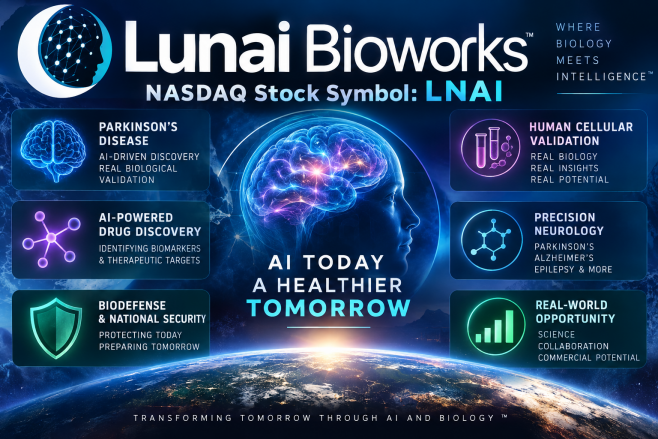


New worldwide agreement adds human cellular validation to Lunai's AI-driven Parkinson's platform, creating a potential path from patient subtypes and biomarkers to biological mechanisms and therapeutic targets. Positioned for $400M to $1.2 Billion US Countermeasures Program with AI Platform to Meet Battlefield and Terrorism Threats. $LNAI Names Six Broker-Dealers in Expanded Naked Short Selling Suit
SACRAMENTO, Calif. - EntSun -- Lunai Bioworks, Inc. (N A S D A Q: LNAI) $LNAI is continuing to build an increasingly sophisticated platform at the intersection of artificial intelligence, precision medicine, neuroscience and biodefense — and its latest Parkinson's development could become one of the company's most important pieces of the story.
Lunai has announced an exclusive worldwide license and collaboration agreement with Tanaist, Inc., adding human cellular phenotyping capabilities to its growing Parkinson's disease discovery and validation platform.
The agreement is significant because it addresses a critical question facing AI-driven drug discovery: Can computationally identified patient subtypes and disease signals be reproduced in actual human biology?
Through its wholly owned BioSymetrics subsidiary and its Augusta AI platform, Lunai has already identified three clinically distinct Parkinson's patient subtypes from longitudinal clinical and proteomic data. The new Tanaist collaboration is designed to take that work another step — connecting those patient-defined subtypes to measurable differences in human cellular biology.
That could create a more complete development pathway:
Patient Stratification → Biological Validation → Biomarkers → Therapeutic Targets
Tanaist Adds a New Biological Lens
Under the agreement, Lunai receives exclusive rights to Tanaist's licensed cellular phenotyping technology within the Parkinson's disease field for programs based on Lunai's patient phenoclusters.
The companies plan to evaluate whether Lunai's clinical and proteomic signatures can be reproduced across additional Parkinson's cohorts and whether those signatures correspond to distinct cellular phenotypes.
That is an important distinction.
Rather than stopping with an AI-generated classification, Lunai is seeking to determine whether those classifications have underlying biological meaning.
Tanaist's precision-medicine platform combines patient data with dynamic human cellular phenotyping. According to the companies, the scientific approach supporting the platform has been described in peer-reviewed research published in Nature Genetics and Science Translational Medicine, including research connecting human cellular phenotypes with genetic mechanisms, disease biology and potential therapeutic targets.
For Lunai, that creates another independent validation layer around its Parkinson's program.
Three Parkinson's Subtypes Become the Foundation
Lunai previously analyzed longitudinal clinical information and more than 4,500 proteomic probes from more than 650 participants in the Parkinson's Progression Markers Initiative (PPMI).
More on EntSun News
The Augusta AI analysis identified three clinically distinct Parkinson's subtypes associated with different disease-progression patterns.
The groups were characterized by:
The analysis connected baseline clinical and proteomic characteristics with subsequent disease progression over a median follow-up of approximately 2.5 years, with many participants followed for more than five years.
The next question is arguably even more important: Do these differences correspond to different underlying biology?
The Tanaist agreement is designed to help answer that question.
If the patient subtypes can be reproduced across independent cohorts and connected to measurable cellular mechanisms, the findings could potentially become more useful for patient enrichment, biomarker development and therapeutic-target selection.
LNAI Is Building Multiple Validation Paths
The Tanaist agreement also complements Lunai's previously announced collaboration with BrainStorm Therapeutics.
In August, Lunai announced a definitive Master Collaboration Agreement with BrainStorm focused on Parkinson's disease, with an initial data readout targeted for the first half of 2027.
That collaboration combines Lunai's AI-based patient stratification and biomarker capabilities with BrainStorm's patient-derived human midbrain organoid technology.
Together, the BrainStorm and Tanaist relationships give Lunai multiple experimental approaches for testing its computational findings.
The strategic objective is becoming clearer: Lunai is not simply attempting to use AI to identify patterns in Parkinson's disease. It is building a framework designed to determine which AI-derived signals are reproducible, biologically meaningful and potentially actionable for therapeutic development.
From AI Discovery Toward Therapeutic Application
This is where the newest agreement could become particularly interesting to investors.
AI can identify patterns across enormous datasets that may be difficult to recognize using traditional approaches. But pharmaceutical development ultimately requires biological validation.
Lunai's stated strategy is therefore moving toward a more integrated model in which:
AI identifies patient subtypes → human biology tests those hypotheses → biomarkers help identify relevant patients → therapeutic targets can be prioritized.
Dr. Gabe Musso, Chief Scientific Officer at BioSymetrics, described the Tanaist collaboration as an important step in moving Lunai's Parkinson's findings from computational discovery toward therapeutic application.
The company says Lunai will own collaboration-generated analyses, biomarker findings and other results as provided under the agreement, while Tanaist retains ownership of its underlying platform.
Parkinson's Is Only One Part of the LNAI Story
While the Parkinson's platform is rapidly becoming a major component of the investment narrative, Lunai's broader strategy remains diversified.
More on EntSun News
On September 16, 2026, BioSymetrics reported results from a technical case study evaluating AI-based screening for potential acetylcholinesterase (AChE) inhibition. Using NIH Tox21 data covering 9,667 compounds, Lunai reported an AUROC of 0.88, along with 33% precision at 70% recall and approximately 5.1-fold enrichment versus the dataset's reported 6.4% prevalence of AChE-active entries.
The company positioned the structure-based system as a potential downstream screening layer for molecules generated by AI systems, while emphasizing that the work is a technical case study and not evidence of clinical neurotoxicity prevention or a comprehensive chemical-threat detection system.
Lunai has also been pursuing biodefense applications and a revenue-generating defense collaboration, giving the company potential applications beyond conventional pharmaceutical discovery.
Key Catalysts Investors Will Be Watching
The rapidly expanding platform gives LNAI several areas to watch as the company moves forward:
Lunai has also been dealing with corporate and capital-markets issues, including litigation involving alleged naked short selling. In August, the company announced that its Second Amended Complaint named six registered broker-dealers and two broker-dealer principals as defendants. Those allegations remain subject to the judicial process. A September 4 company correction stated that it changed only the reference link to the complaint and did not alter the substantive content of the earlier release.
An Increasingly Interesting AI-Biotech Convergence Story
The latest Tanaist agreement potentially adds an important missing piece to the Lunai Bioworks story.
The company already has the AI, the patient data, the proteomic analysis and the identified Parkinson's subtypes. Now it is adding another avenue for determining whether those computational discoveries correspond to real, measurable human cellular biology.
That evolution could be important.
The potential value of AI-driven drug discovery ultimately depends not simply on finding patterns, but on determining which patterns can withstand independent validation and translate into meaningful biological and therapeutic hypotheses.
Lunai is attempting to build exactly that bridge.
With Tanaist providing human cellular phenotyping, BrainStorm providing complementary experimental validation, BioSymetrics providing AI-powered patient stratification, and the company continuing its chemical-risk and biodefense work, LNAI is developing a platform that spans several rapidly advancing areas of biotechnology.
The combination of AI-driven precision medicine, human biological validation, Parkinson's disease research, biodefense and chemical-risk screening gives Lunai Bioworks $LNAI multifaceted story for investors to follow.
For more information on LNAI visit: www.lunaibioworks.com
--------------------------------------------------------------------------------------------------------------
Media Contact
Company Name: Lunai Bioworks (N A S D A Q: LNAI)
Contact: Aysha Rashid
Email: aysha@lunaibioworks.com or Info@lunaibioworks.com
Phone: (424) 222-9301
Country: United States
DISCLAIMER: https://corporateads.com/disclaimer/
Disclosure listed on the CorporateAds website
Lunai has announced an exclusive worldwide license and collaboration agreement with Tanaist, Inc., adding human cellular phenotyping capabilities to its growing Parkinson's disease discovery and validation platform.
The agreement is significant because it addresses a critical question facing AI-driven drug discovery: Can computationally identified patient subtypes and disease signals be reproduced in actual human biology?
Through its wholly owned BioSymetrics subsidiary and its Augusta AI platform, Lunai has already identified three clinically distinct Parkinson's patient subtypes from longitudinal clinical and proteomic data. The new Tanaist collaboration is designed to take that work another step — connecting those patient-defined subtypes to measurable differences in human cellular biology.
That could create a more complete development pathway:
Patient Stratification → Biological Validation → Biomarkers → Therapeutic Targets
Tanaist Adds a New Biological Lens
Under the agreement, Lunai receives exclusive rights to Tanaist's licensed cellular phenotyping technology within the Parkinson's disease field for programs based on Lunai's patient phenoclusters.
The companies plan to evaluate whether Lunai's clinical and proteomic signatures can be reproduced across additional Parkinson's cohorts and whether those signatures correspond to distinct cellular phenotypes.
That is an important distinction.
Rather than stopping with an AI-generated classification, Lunai is seeking to determine whether those classifications have underlying biological meaning.
Tanaist's precision-medicine platform combines patient data with dynamic human cellular phenotyping. According to the companies, the scientific approach supporting the platform has been described in peer-reviewed research published in Nature Genetics and Science Translational Medicine, including research connecting human cellular phenotypes with genetic mechanisms, disease biology and potential therapeutic targets.
For Lunai, that creates another independent validation layer around its Parkinson's program.
Three Parkinson's Subtypes Become the Foundation
Lunai previously analyzed longitudinal clinical information and more than 4,500 proteomic probes from more than 650 participants in the Parkinson's Progression Markers Initiative (PPMI).
More on EntSun News
- Industrial & systems engineering educator and professional to lead global strategic partnerships for professional society
- "For Love Of Will," Staged Reading at Flea Theatre, NYC, Oct 26
- Convergence of AI, Wearable Technology, Remote Patient Monitoring and Real-World Healthcare: PomDoctor Ltd. (N A S D A Q: POM)
- Service Guys Urges Ontario Homeowners to Book Chimney Cleaning and WETT Inspections Before the 2026 Heating Season
- D.C. Douglas Voices Sygna Suit Lysandre (Alt.) & Chi-Yu in Pokémon Masters EX
The Augusta AI analysis identified three clinically distinct Parkinson's subtypes associated with different disease-progression patterns.
The groups were characterized by:
- Fast motor progression
- Rapid neurological and cognitive decline
- Female-enriched functional impairment
The analysis connected baseline clinical and proteomic characteristics with subsequent disease progression over a median follow-up of approximately 2.5 years, with many participants followed for more than five years.
The next question is arguably even more important: Do these differences correspond to different underlying biology?
The Tanaist agreement is designed to help answer that question.
If the patient subtypes can be reproduced across independent cohorts and connected to measurable cellular mechanisms, the findings could potentially become more useful for patient enrichment, biomarker development and therapeutic-target selection.
LNAI Is Building Multiple Validation Paths
The Tanaist agreement also complements Lunai's previously announced collaboration with BrainStorm Therapeutics.
In August, Lunai announced a definitive Master Collaboration Agreement with BrainStorm focused on Parkinson's disease, with an initial data readout targeted for the first half of 2027.
That collaboration combines Lunai's AI-based patient stratification and biomarker capabilities with BrainStorm's patient-derived human midbrain organoid technology.
Together, the BrainStorm and Tanaist relationships give Lunai multiple experimental approaches for testing its computational findings.
The strategic objective is becoming clearer: Lunai is not simply attempting to use AI to identify patterns in Parkinson's disease. It is building a framework designed to determine which AI-derived signals are reproducible, biologically meaningful and potentially actionable for therapeutic development.
From AI Discovery Toward Therapeutic Application
This is where the newest agreement could become particularly interesting to investors.
AI can identify patterns across enormous datasets that may be difficult to recognize using traditional approaches. But pharmaceutical development ultimately requires biological validation.
Lunai's stated strategy is therefore moving toward a more integrated model in which:
AI identifies patient subtypes → human biology tests those hypotheses → biomarkers help identify relevant patients → therapeutic targets can be prioritized.
Dr. Gabe Musso, Chief Scientific Officer at BioSymetrics, described the Tanaist collaboration as an important step in moving Lunai's Parkinson's findings from computational discovery toward therapeutic application.
The company says Lunai will own collaboration-generated analyses, biomarker findings and other results as provided under the agreement, while Tanaist retains ownership of its underlying platform.
Parkinson's Is Only One Part of the LNAI Story
While the Parkinson's platform is rapidly becoming a major component of the investment narrative, Lunai's broader strategy remains diversified.
More on EntSun News
- Systemores Launches Fork: Web-Native Interactive Video Engine Debuts With Thriller 'The Hollow'
- WOWX Completes Its Transition from CEX to Decentralized Derivatives Infrastructure
- At 58, Lifelong Gamer Censors Mature Game Visuals but Preserves the Story
- Voice Actor D.C. Douglas Appears as the Speaker of Books in Disney's "Vampirina: Teenage Vampire"
- Mississippi Rapper Paperbaby O.D. Releases Debut Album 'Paperbaby'
On September 16, 2026, BioSymetrics reported results from a technical case study evaluating AI-based screening for potential acetylcholinesterase (AChE) inhibition. Using NIH Tox21 data covering 9,667 compounds, Lunai reported an AUROC of 0.88, along with 33% precision at 70% recall and approximately 5.1-fold enrichment versus the dataset's reported 6.4% prevalence of AChE-active entries.
The company positioned the structure-based system as a potential downstream screening layer for molecules generated by AI systems, while emphasizing that the work is a technical case study and not evidence of clinical neurotoxicity prevention or a comprehensive chemical-threat detection system.
Lunai has also been pursuing biodefense applications and a revenue-generating defense collaboration, giving the company potential applications beyond conventional pharmaceutical discovery.
Key Catalysts Investors Will Be Watching
The rapidly expanding platform gives LNAI several areas to watch as the company moves forward:
- Tanaist Parkinson's validation work and additional cohort analysis
- BrainStorm collaboration and targeted first-half 2027 data
- Validation of Lunai's three Parkinson's patient subtypes
- Potential biomarker and therapeutic-target discoveries
- Continued development of AI-powered chemical-risk screening
- Additional biodefense and government opportunities
Lunai has also been dealing with corporate and capital-markets issues, including litigation involving alleged naked short selling. In August, the company announced that its Second Amended Complaint named six registered broker-dealers and two broker-dealer principals as defendants. Those allegations remain subject to the judicial process. A September 4 company correction stated that it changed only the reference link to the complaint and did not alter the substantive content of the earlier release.
An Increasingly Interesting AI-Biotech Convergence Story
The latest Tanaist agreement potentially adds an important missing piece to the Lunai Bioworks story.
The company already has the AI, the patient data, the proteomic analysis and the identified Parkinson's subtypes. Now it is adding another avenue for determining whether those computational discoveries correspond to real, measurable human cellular biology.
That evolution could be important.
The potential value of AI-driven drug discovery ultimately depends not simply on finding patterns, but on determining which patterns can withstand independent validation and translate into meaningful biological and therapeutic hypotheses.
Lunai is attempting to build exactly that bridge.
With Tanaist providing human cellular phenotyping, BrainStorm providing complementary experimental validation, BioSymetrics providing AI-powered patient stratification, and the company continuing its chemical-risk and biodefense work, LNAI is developing a platform that spans several rapidly advancing areas of biotechnology.
The combination of AI-driven precision medicine, human biological validation, Parkinson's disease research, biodefense and chemical-risk screening gives Lunai Bioworks $LNAI multifaceted story for investors to follow.
For more information on LNAI visit: www.lunaibioworks.com
--------------------------------------------------------------------------------------------------------------
Media Contact
Company Name: Lunai Bioworks (N A S D A Q: LNAI)
Contact: Aysha Rashid
Email: aysha@lunaibioworks.com or Info@lunaibioworks.com
Phone: (424) 222-9301
Country: United States
DISCLAIMER: https://corporateads.com/disclaimer/
Disclosure listed on the CorporateAds website
Source: CorporateAds
Filed Under: Business
0 Comments
Latest on EntSun News
- Coinfiliate Launches Platform to Helps Shoppers Earn Cashback and Creators Earn Referral Rewards
- Russ Lorenson Announces "What I Want For Christmas (20th Anniversary Edition)"
- HPA Talent Signs Stand-up Comedian Alexis Carabano For Management
- Holiday Gambling Spending Expected to Rise 12% in December
- RAS AP Consulting Issues National Compliance Alert and Launches Q4 2026 AP Readiness Program Ahead of IRS FIRE → IRIS Cutover
- Claude Zdanow named Managing Director in Miami, Florida
- Pregis Launches Sharp InfinX: On-Demand Rightsized Mailing System Delivering a Precision-Sized Mailer for Every Order
- BAG FUEL Live Announces high profile MLK Weekend Event at NYC'S Legendary S.O.B.'S
- netElastic Announces vBNG And CGNAT 2.0 General Availability
- Council Members Lynne B Kennedy and Kristine D Scott Cultural Reports Close Indigenous Film Retreats
- Fort Myers Brewing Taps Into Oktoberfest, Oct. 15–18, With Beers Nine Months in the Making
- Intelligence Daily Features "Producer Kirk Shaw: 90 Seconds to Make You Care"
- Invented in 2023, Scream Score® uses heart-rate data to measure fear during live entertainment
- Postmortem Pathology Highlights Private Autopsy Options for Las Vegas Families During Summer Months
- Postmortem Pathology Offers Sacramento Families Independent Answers on a Short Timeline
- Teens Wanna Know Launches TWK Play, a Free Web Hub for Watching and Listening
- Love All Acquires UpDown Sport, Bringing Tennis and Pickleball Bags Into Its Growing Brand Portfolio
- NEW Three Fully Furnished Single-Family Model Homes at Heritage at South Brunswick
- Hot Chocolate, Why Are You So Cold?
- After 35 Years, Christian Radio Host Marina Maria Publishes the Novel She Never Forgot