Popular on EntSun
- Western Canadian Host James Cousineau Finishes 11th In Global "Top Host" Competition - 278
- Majo Aguilar inaugurates the Paseo de las Estrellas at Plaza Mexico with the unveiling of her Estrella Maya - 228
- Bacchus Wine & Spirits and Michelin Guide–Recommended Ethel's Fancy to Host Exclusive LOUIS XIII Limited Edition Diwali Decanter Celebration - 218
- Who Won Paris Fashion Week SS27? Dior Took About 45% of the Week's $795.6M in Earned Media Value - 182
- BetQL Inserts a Human Connection to Sports Betting Through Live Shows - 137
- Past, Present and Future Emerge in PerfectvilleUSA - 132
- "Martin" Star Bruh Man and R&B Star Alisa Peoples-Yarbrough Join "Mother of Inmates" — Featured on FOX 4 News - 126
- Grant Fonda's Original Score for JIMMY Out Now - 125
- Made to Order, Not Made for Landfill: Leather Workshop Takes a Different Road into Black Friday - 110
- Jamie Foxx's SKVLK Fest Sets the Record Straight on Stabbing Reports Following Star-Studded Celebration - 108
Mission To The Moon: Stratasys Joins Forces With Lockheed Martin And Padt To Engineer Advanced 3d Printed Parts For Nasa's Orion Mission
EntSun News/10726063

Stratasys 3D printers and materials provide extremely high levels of strength, durability and thermal properties to power missions to deep space
Variant of new Stratasys Antero™ 800NA, PEKK-based material offers electro-static dissipative (ESD) functionality for advanced mechanical, chemical, and thermal properties
TEMPE, Ariz. & MINNEAPOLIS & REHOVOT, Israel - April 17, 2018 - EntSun -- Stratasys Ltd. a global leader in applied additive technology solutions, and Phoenix Analysis & Design Technologies, Inc. (PADT) jointly announced the companies are teaming with Lockheed Martin Space to deliver next-generation 3D printed parts for NASA's Orion deep-space spacecraft. Key to the project are Stratasys advanced materials – including an ESD variant of the new Antero™ 800NA, a PEKK-based thermoplastic offering high performance mechanical, chemical, and thermal properties.
Orion is NASA's spacecraft that will send astronauts to the Moon and beyond. Orion's next test flight, dubbed Exploration Mission-1 (EM-1), will be the first integration mission with the world's most powerful rocket, the Space Launch System, where an un-crewed Orion will fly thousands of miles beyond the Moon during an approximately three week mission.
The following flight, EM-2, will also go near the Moon, but with astronauts on-board, a first since 1972 and will enable NASA to prepare for increasingly complex missions in deep space. The mission will use more than 100 3D printed production parts on board – engineered in conjunction with Lockheed Martin, Stratasys and PADT.
The production-grade, thermoplastic 3D printed parts on NASA's Orion vehicle are produced at the Additive Manufacturing Lab at Lockheed Martin in conjunction with PADT, which now includes the latest in Stratasys 3D printers and materials. Using advanced materials such as ULTEM 9085 and the new Antero material incorporating critical electro-static dissipative (ESD) functionality – NASA could meet key requirements for 3D printed parts to perform in the extremes of deep space. Antero is ideally suited to meet NASA's requirements for heat and chemical resistance, along with the ability to withstand high mechanical loads.
More on EntSun News
"Working with PADT, Stratasys, and NASA has enabled us to achieve highly consistent builds that move beyond the realm of prototyping and into production," said Brian Kaplun, Manager of Additive Manufacturing at Lockheed Martin Space. "We're not just creating parts, we're reshaping our production strategy to make spacecraft more affordable and faster to produce."
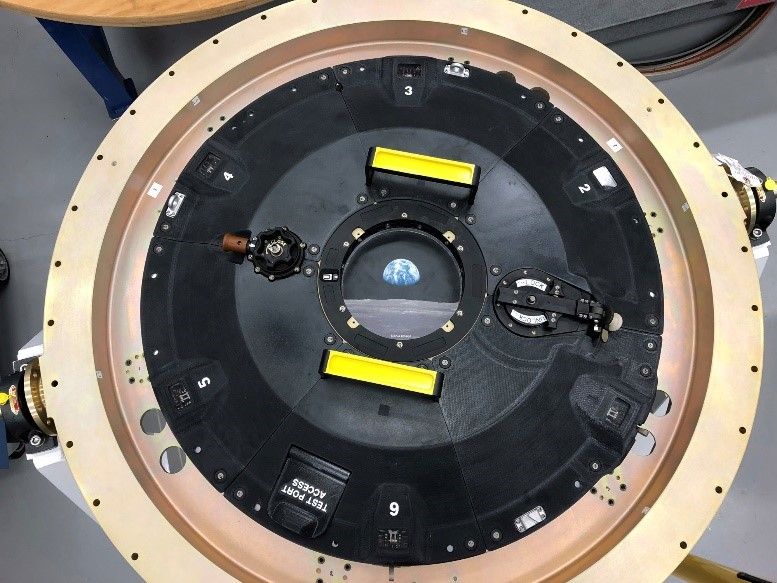
The Lockheed Martin, Stratasys and PADT-engineered collaboration is differentiated by an ability to create consistency and repeatability in mass scale across the entire additive manufacturing part production process. Lockheed Martin is also one of the first customers leveraging Stratasys' Antero, using the new thermoplastic for a critical part situated just outside of Orion's docking hatch. The complex part consists of six individual 3D printed components locked together to form a ring on the craft's exterior. The part is currently on display in the Lockheed Martin booth #603 at the 34th Space Symposium in Colorado Springs, CO April 16-19.
"The demands of space travel require extremely high performance materials and the most rigorous manufacturing processes in the industry. Part integrity and repeatability are essential and must pass NASA's demanding testing and validation process," said Scott Sevcik, Vice President of Manufacturing at Stratasys. "Based on decades of experience delivering strong and lightweight additive manufacturing solutions for leaders across the aerospace industry, Stratasys technology is ideally suited to match the high-reliability manufacturing processes required for production parts in space exploration."
"It's exciting to be a part of the Orion mission and Lockheed Martin's efforts to transition additive manufacturing from prototyping to production," said Rey Chu, Principal and Co-Owner at PADT. "Additive manufacturing technology and materials have come a long way to become a full-fledged end-use manufacturing option."
PADT is currently joining Stratasys in their booth #537 at this week's 34th Space Symposium. For further detail on how Stratasys is transforming aerospace and space exploration through 3D printing please visit: http://www.stratasys.com/aerospace.
More on EntSun News
Stratasys is a global leader in applied additive technology solutions for industries including Aerospace, Automotive, Healthcare, Consumer Products and Education. For nearly 30 years, a deep and ongoing focus on customers' business requirements has fueled purposeful innovations—1,200 granted and pending additive technology patents to date—that create new value across product lifecycle processes, from design prototypes to manufacturing tools and final production parts. The Stratasys 3D printing ecosystem of solutions and expertise—advanced materials; software with voxel level control; precise, repeatable and reliable FDM and PolyJet 3D printers; application-based expert services; on-demand parts and industry-defining partnerships—works to ensure seamless integration into each customer's evolving workflow. Fulfilling the real-world potential of additive, Stratasys delivers breakthrough industry-specific applications that accelerate business processes, optimize value chains and drive business performance improvements for thousands of future-ready leaders. Corporate headquarters: Minneapolis, Minnesota and Rehovot, Israel. Online at: www.stratasys.com, http://blog.stratasys.com and LinkedIn.
Phoenix Analysis and Design Technologies (PADT) is an engineering product and services company that focuses on helping customers who develop physical products by providing Numerical Simulation, Product Development, and 3D printing solutions. PADT's worldwide reputation for technical excellence and experienced staff is based on its proven record of building long-term win-win partnerships with vendors and customers. Since its establishment in 1994, companies have relied on PADT because "We Make Innovation Work". With over 80 employees, PADT services customers from its headquarters in Tempe, Arizona, and from offices in Torrance, California, Littleton, Colorado, Albuquerque, New Mexico, Austin, Texas, and Murray, Utah. More information on PADT can be found at www.padtinc.com.
Lockheed Martin, headquartered in Bethesda, Maryland, is a global security and aerospace company that employs approximately 97,000 people worldwide and is principally engaged in the research, design, development, manufacture, integration, and sustainment of advanced technology systems, products and services.
Orion is NASA's spacecraft that will send astronauts to the Moon and beyond. Orion's next test flight, dubbed Exploration Mission-1 (EM-1), will be the first integration mission with the world's most powerful rocket, the Space Launch System, where an un-crewed Orion will fly thousands of miles beyond the Moon during an approximately three week mission.
The following flight, EM-2, will also go near the Moon, but with astronauts on-board, a first since 1972 and will enable NASA to prepare for increasingly complex missions in deep space. The mission will use more than 100 3D printed production parts on board – engineered in conjunction with Lockheed Martin, Stratasys and PADT.
The production-grade, thermoplastic 3D printed parts on NASA's Orion vehicle are produced at the Additive Manufacturing Lab at Lockheed Martin in conjunction with PADT, which now includes the latest in Stratasys 3D printers and materials. Using advanced materials such as ULTEM 9085 and the new Antero material incorporating critical electro-static dissipative (ESD) functionality – NASA could meet key requirements for 3D printed parts to perform in the extremes of deep space. Antero is ideally suited to meet NASA's requirements for heat and chemical resistance, along with the ability to withstand high mechanical loads.
More on EntSun News
- Composer Ostap Myryk Highlights Challenges of International Baroque Music Project
- Purple Camero Releases New Single "Mary Lies"
- Relief Works. That's the Problem
- United Filmmakers Seeks Real Estate Development Partner in Tanzania and Zanzibar
- Giving a Rolex This Holiday Season? David and Sons Timepieces Shares What to Know Before You Buy
"Working with PADT, Stratasys, and NASA has enabled us to achieve highly consistent builds that move beyond the realm of prototyping and into production," said Brian Kaplun, Manager of Additive Manufacturing at Lockheed Martin Space. "We're not just creating parts, we're reshaping our production strategy to make spacecraft more affordable and faster to produce."
The Lockheed Martin, Stratasys and PADT-engineered collaboration is differentiated by an ability to create consistency and repeatability in mass scale across the entire additive manufacturing part production process. Lockheed Martin is also one of the first customers leveraging Stratasys' Antero, using the new thermoplastic for a critical part situated just outside of Orion's docking hatch. The complex part consists of six individual 3D printed components locked together to form a ring on the craft's exterior. The part is currently on display in the Lockheed Martin booth #603 at the 34th Space Symposium in Colorado Springs, CO April 16-19.
"The demands of space travel require extremely high performance materials and the most rigorous manufacturing processes in the industry. Part integrity and repeatability are essential and must pass NASA's demanding testing and validation process," said Scott Sevcik, Vice President of Manufacturing at Stratasys. "Based on decades of experience delivering strong and lightweight additive manufacturing solutions for leaders across the aerospace industry, Stratasys technology is ideally suited to match the high-reliability manufacturing processes required for production parts in space exploration."
"It's exciting to be a part of the Orion mission and Lockheed Martin's efforts to transition additive manufacturing from prototyping to production," said Rey Chu, Principal and Co-Owner at PADT. "Additive manufacturing technology and materials have come a long way to become a full-fledged end-use manufacturing option."
PADT is currently joining Stratasys in their booth #537 at this week's 34th Space Symposium. For further detail on how Stratasys is transforming aerospace and space exploration through 3D printing please visit: http://www.stratasys.com/aerospace.
More on EntSun News
- Keebos, the Original Crossbody Phone Case, Adds the Full iPhone 18 Lineup Ahead of the Holidays
- TOKSTAR Welcomes NBA 2K Star Young Wayne
- San Diego Premiere of "Mrs. Christmas," a Holiday Musical by Award-Winning Playwright Tom Jacob
- KKM Launches Curated Online Shop
- Weinberg Center to hold centennial celebration on exact date the theater opened 100 years ago
Stratasys is a global leader in applied additive technology solutions for industries including Aerospace, Automotive, Healthcare, Consumer Products and Education. For nearly 30 years, a deep and ongoing focus on customers' business requirements has fueled purposeful innovations—1,200 granted and pending additive technology patents to date—that create new value across product lifecycle processes, from design prototypes to manufacturing tools and final production parts. The Stratasys 3D printing ecosystem of solutions and expertise—advanced materials; software with voxel level control; precise, repeatable and reliable FDM and PolyJet 3D printers; application-based expert services; on-demand parts and industry-defining partnerships—works to ensure seamless integration into each customer's evolving workflow. Fulfilling the real-world potential of additive, Stratasys delivers breakthrough industry-specific applications that accelerate business processes, optimize value chains and drive business performance improvements for thousands of future-ready leaders. Corporate headquarters: Minneapolis, Minnesota and Rehovot, Israel. Online at: www.stratasys.com, http://blog.stratasys.com and LinkedIn.
Phoenix Analysis and Design Technologies (PADT) is an engineering product and services company that focuses on helping customers who develop physical products by providing Numerical Simulation, Product Development, and 3D printing solutions. PADT's worldwide reputation for technical excellence and experienced staff is based on its proven record of building long-term win-win partnerships with vendors and customers. Since its establishment in 1994, companies have relied on PADT because "We Make Innovation Work". With over 80 employees, PADT services customers from its headquarters in Tempe, Arizona, and from offices in Torrance, California, Littleton, Colorado, Albuquerque, New Mexico, Austin, Texas, and Murray, Utah. More information on PADT can be found at www.padtinc.com.
Lockheed Martin, headquartered in Bethesda, Maryland, is a global security and aerospace company that employs approximately 97,000 people worldwide and is principally engaged in the research, design, development, manufacture, integration, and sustainment of advanced technology systems, products and services.
Source: PADT, Inc
0 Comments
Latest on EntSun News
- BeReal Wear launches its Black Friday event with up to 70% off
- "Martin" Star Bruh Man and R&B Star Alisa Peoples-Yarbrough Join "Mother of Inmates" — Featured on FOX 4 News
- "Dick Dyman: Head Hunter" Episode 2, "The Client," Premieres November 28 on YouTube
- Pixel Swarm Drones Illuminates the Sky for The Bath Club's 100th Anniversary Celebration
- 12 Points Asia Launches Fan Hub After Historic First Eurovision Asia Contest
- Best Private Vacation Rentals in St. George, Utah: Experience Luxury Near Zion & Sand Hollow
- Nious Media Expands Gaming Coverage With 2026 Game & Geek Expo Special
- La'Nardo Myrick Sr Salutes House of Myrick Collaborators and Announces Two Baroque Albums
- Producer 9-0 Credits Southern Miss and Ole Miss as Baroque Project Takes Shape
- Resident Evil's Wesker Is Now Beavis's "Bold New Voice" on Mike Judge's Beavis & Butt-Head
- Resident Evil's Wesker, D.C. Douglas, Plays the Villain in Texas Horror-Noir WHAT DID YOU DO?
- Hollywood Glam Night, December 30th, Marilyn Monroe Foundation & Anastasia Magazine
- Canadian Streamer CGP Spotlight Marks One Year With 1,000-Title Challenge
- Nine Platinum Honors Lead Scientology Media Productions' 12 Wins at 2026 MarCom Awards
- The Creative Vision Behind Hollywood Music in Media Award-Nominated Mark Isham: The Voice Within
- El Show de Bernie: NJ Studio Launches Latino Animated Late-Night Talk Show Hosted by a Mexican Bear
- 98.FM Gospel Radio Realigns Airwaves: Prioritizing Scripture and New Artists Over Secular Metrics
- Entertainment Vet Latrina Blackberry Brings Upscale 40+ Experience "The Congo Den" to Spring, Texas
- Music For Good: Brooklyn's Legendary Gleason's Gym Transforms Into A Live Music Venue For One Night
- The Dining Room Sees Everything