Popular on EntSun
- From Speech Therapy to 300+ Episodes: Brother Marcus Turns His Voice Into a Movement Launching a 24/7 Inspiration Radio Network on Day 100 of the Year - 297
- Homeowner Prep Announces Strategic Language Shift: Replacing "Renters" with "Future Homeowners" to Inspire Wealth-Building Mindsets - 200
- AI Disruption Meets Marine Scale: Off The Hook YS, Inc. (N Y S E American: OTH) Targets Breakout Growth with NextBoat Launch and Aggressive Expansion - 153
- Canadian Agency YCAA Is Changing How Actors Build Careers in the Age of Streaming and Audience Fragmentation - 137
- Heritage at Manalapan Introduces New Single-Family Home Community in One of Monmouth County's Most Desirable Locations - 119
- UK Financial Ltd Tokenized LTNS 1, A $1.1 T Asset-Backed ERC-3643 Security Token with 11 On-Chain Contracts Verifying, Compliant Real-World Value - 118
- PlanetAI Nature Space (PNS), certificadora Europea, lanza su plataforma EUDR-PNS Ready basada en IA, satélites y trazabilidad blockchain - 117
- Evolve Construction Mobilizes Commercial Storm Response Across Illinois With AI-Powered Damage Documentation and Public Adjusters Partnership - 113
- KeysCaribbean Offers 'Skip-the-Crowds' Savings With 15 Percent Off April Stays - 112
- SeeVideo.dance Goes Live: Dual-Engine AI Video Studio Brings Seedance 2.0 and Kling 3.0 to Creative Professionals - 108
Similar on EntSun
- CCHR Rejects Global Psychiatric Push to Electroshock Children
- Permian Museum Adds Photos of Fossils Discovered on a Meteorite
- Larry R. Wasion's Jump Gate 2: Teleporter Expands the Time Travel Universe with High-Stakes Action and Ethical Dilemmas
- Congressional Roundtable Exposes Mental Health Crisis: More Spending and Treatment, Worse Results – CCHR Demands Accountability
- CCHR: Psychiatric Drugs Fuel Rising Death Toll: National Adverse Drug Event Awareness Day Confronts America's Medication Crisis
- Understanding Unexpected Death: Why Independent Autopsies Matter in Cases Without Clear Cause
- Forced Psychiatric Hospitalization Fails Vulnerable People: CCHR Urges Repeal Amid Rising U.S. Policies
- Why Your Berberine Failed: RevGenetics Unveils the Absorption Gap Solution
- CCHR Warns: Psychiatric Diagnoses Without Biological Proof Now Used to Justify Euthanasia
- CCHR: CIA Mind-Control Files Raise Urgent Questions as Millions Take Psychotropic Drugs
Hubble Tension Solved? Study finds evidence of an 'Invisible Bias' in How We Measure the Universe
EntSun News/11084503
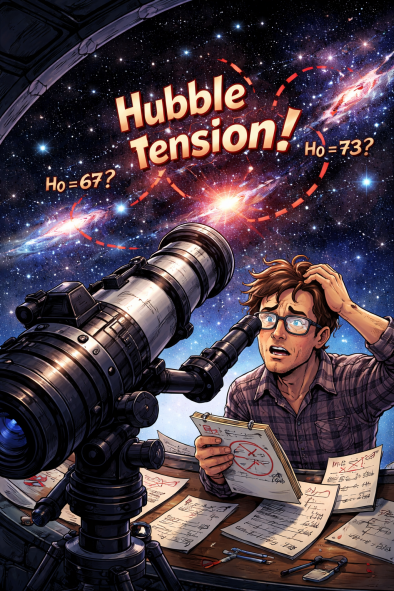
A newly published analysis proposes that the famous "Hubble tension" likely stems from an inference bias, occurring when standard General Relativity is applied to gravitational wave data that actually follows modified propagation.
HONOLULU - EntSun -- The long-standing "Hubble tension"—a discrepancy between early-universe measurements of cosmic expansion and late-universe distance measurements—remains one of modern cosmology's most debated puzzles. While the discrepancy is often interpreted as evidence for new physics in the universe's expansion history, a new study proposes a different possibility: part of the tension may arise from how distances are inferred.
In a recent implications analysis, independent researcher Aiden B. Smith examines whether gravitational-wave distance measurements—specifically from so-called "dark sirens"—could be subtly affected by assumptions about how gravitational waves propagate across cosmological distances.
More on EntSun News
Dark sirens are gravitational-wave events without confirmed electromagnetic counterparts. Their distances are inferred statistically using galaxy catalogues. Smith's analysis uses his previously identified propagation anomaly in the GWTC-3 dataset as a template and asks: if gravitational-wave amplitudes decay slightly differently than predicted by General Relativity, what effect would that have on cosmological inference?
The study finds that, under this hypothesis, applying standard General Relativity during distance compression can induce a shift in the inferred Hubble constant of approximately +2 to +5 km/s/Mpc—comparable in scale to the observed tension.
Importantly, the paper does not claim to resolve the Hubble tension. Instead, it demonstrates that gravitational-wave propagation assumptions are not mathematically neutral: if even modest deviations are present, they can bias late-time inferences.
The modified-propagation preference identified in the GWTC-3 dark-siren sample has been subjected to internal calibration and stress testing, including injection-based null simulations and robustness checks against selection and catalog perturbations. While the signal remains statistically unusual within the tested framework, confirming its physical origin will require independent replication and larger gravitational-wave samples from future observing runs.
More on EntSun News
If confirmed, the results would suggest that part of the Hubble tension may reflect a subtle distance-inference effect rather than a fundamental breakdown of the expansion model itself. If not, the analysis provides a quantitative diagnostic of where dark-siren cosmology may be vulnerable to systematic effects.
The full study and reproducibility materials are publicly available.
Data and Study Availability: While the work is currently in peer review, the full study is available to read on Smith's research journal at quasardipolephenomenon.org. All code and reproducibility artifacts associated with this analysis can be downloaded via Zenodo (DOI: 10.5281/zenodo.18635659) or accessed on GitHub.
In a recent implications analysis, independent researcher Aiden B. Smith examines whether gravitational-wave distance measurements—specifically from so-called "dark sirens"—could be subtly affected by assumptions about how gravitational waves propagate across cosmological distances.
More on EntSun News
- EduCare Inc. Bridges Critical Gap in Breast Cancer Education with Spanish COPE Library Launch
- Engineering leaders from industry, academia to gather at IISE Annual Conference & Expo in Arlington, Texas
- AI-Driven Neurotechnology Expansion as FDA Path Clears and New Defense Initiative Emerges for NRx Pharmaceuticals (N A S D A Q: NRXP)
- BestDoc Launches AI Call Center for Healthcare
- Professional Corporate Lunch Catering Services for Seamless Office Events in Orlando, Florida
Dark sirens are gravitational-wave events without confirmed electromagnetic counterparts. Their distances are inferred statistically using galaxy catalogues. Smith's analysis uses his previously identified propagation anomaly in the GWTC-3 dataset as a template and asks: if gravitational-wave amplitudes decay slightly differently than predicted by General Relativity, what effect would that have on cosmological inference?
The study finds that, under this hypothesis, applying standard General Relativity during distance compression can induce a shift in the inferred Hubble constant of approximately +2 to +5 km/s/Mpc—comparable in scale to the observed tension.
Importantly, the paper does not claim to resolve the Hubble tension. Instead, it demonstrates that gravitational-wave propagation assumptions are not mathematically neutral: if even modest deviations are present, they can bias late-time inferences.
The modified-propagation preference identified in the GWTC-3 dark-siren sample has been subjected to internal calibration and stress testing, including injection-based null simulations and robustness checks against selection and catalog perturbations. While the signal remains statistically unusual within the tested framework, confirming its physical origin will require independent replication and larger gravitational-wave samples from future observing runs.
More on EntSun News
- Acuvance Appoints Sandeep Sabharwal to Board of Directors, Strengthening Leadership to Support Continued Platform Growth
- Grange Insurance Association to Rebrand as Granwest Insurance on July 1, 2026
- Dr. Rosendo Icochea, MD Recognized for Contributions to Surgical Education and Medical Research
- Giftella Launches AI Gift-Finder App That Replaces Guesswork With Personalized Picks in Seconds
- Beverly.io Announces Nationwide Expansion and Poppins Payroll Partnership for Families
If confirmed, the results would suggest that part of the Hubble tension may reflect a subtle distance-inference effect rather than a fundamental breakdown of the expansion model itself. If not, the analysis provides a quantitative diagnostic of where dark-siren cosmology may be vulnerable to systematic effects.
The full study and reproducibility materials are publicly available.
Data and Study Availability: While the work is currently in peer review, the full study is available to read on Smith's research journal at quasardipolephenomenon.org. All code and reproducibility artifacts associated with this analysis can be downloaded via Zenodo (DOI: 10.5281/zenodo.18635659) or accessed on GitHub.
Source: Aiden Blake Smith
0 Comments
Latest on EntSun News
- Justin Jeansonne and his Music Manager Donna Cardellino Head To Nashville
- Raquel Riley Thomas' AOAGWLLC and Hazel Simpson's Sis to Sis Productions Ink Major Co-Production Deal, Launching Strategic Creative Alliance
- InterMountain Management Announces the Re-opening of Holiday Inn Express & Suites Alexandria
- Bay Street Yard to host "Girls Night Out the Show" on April 20
- CB Stuffer Expands New England Footprint with Launch at Common Man Roadside in Hooksett, NH
- Contracting Resources Group Named to the 2026 Inc. Regionals: Mid-Atlantic List
- PBR returns to Queen Creek Arizona
- Dividend Stock Guru Unveils High Yield Dividend Stock Research Reports
- Charging Into the $30 Billion Heart Failure Market with Late-Stage Momentum, Breakthrough Data, & Strong Financial Backing: Cardiol Therapeutics $CRDL
- Celebrate World Creativity and Innovation Day with the Launch of the Book: World Innovators Cup
- Centrum of Concave Souls Tarot
- All American Home Renovators: Transforming Bathrooms into Masterpieces, One Home at a Time
- Bold Beauty Project Celebrates Anniversary with Collaborative Exhibition at FIU's Miami Beach Urban Studios
- Pacific Emblem Company Launches "Happy 250th Birthday America" Collection and Proud Supporter of the Gary Sinise Foundation
- Joanna Pearl Earns Back-to-Back Film Festival Official Selections In India And Southern California
- 2026 State of Maine Wedding DJ Update
- Bold Beauty Project Announces Exhibition at Palazzo Mora Venice, Italy
- Texas Indie Filmmaker Awards Announces 15 Official Selections for 2026
- "Ethics Under Pressure" Film & Panel April 19 at St. Louis Holocaust Museum
- Financial Educator Jessica Perrone Launches Free "3 Stages of Building Wealth" Course for Women